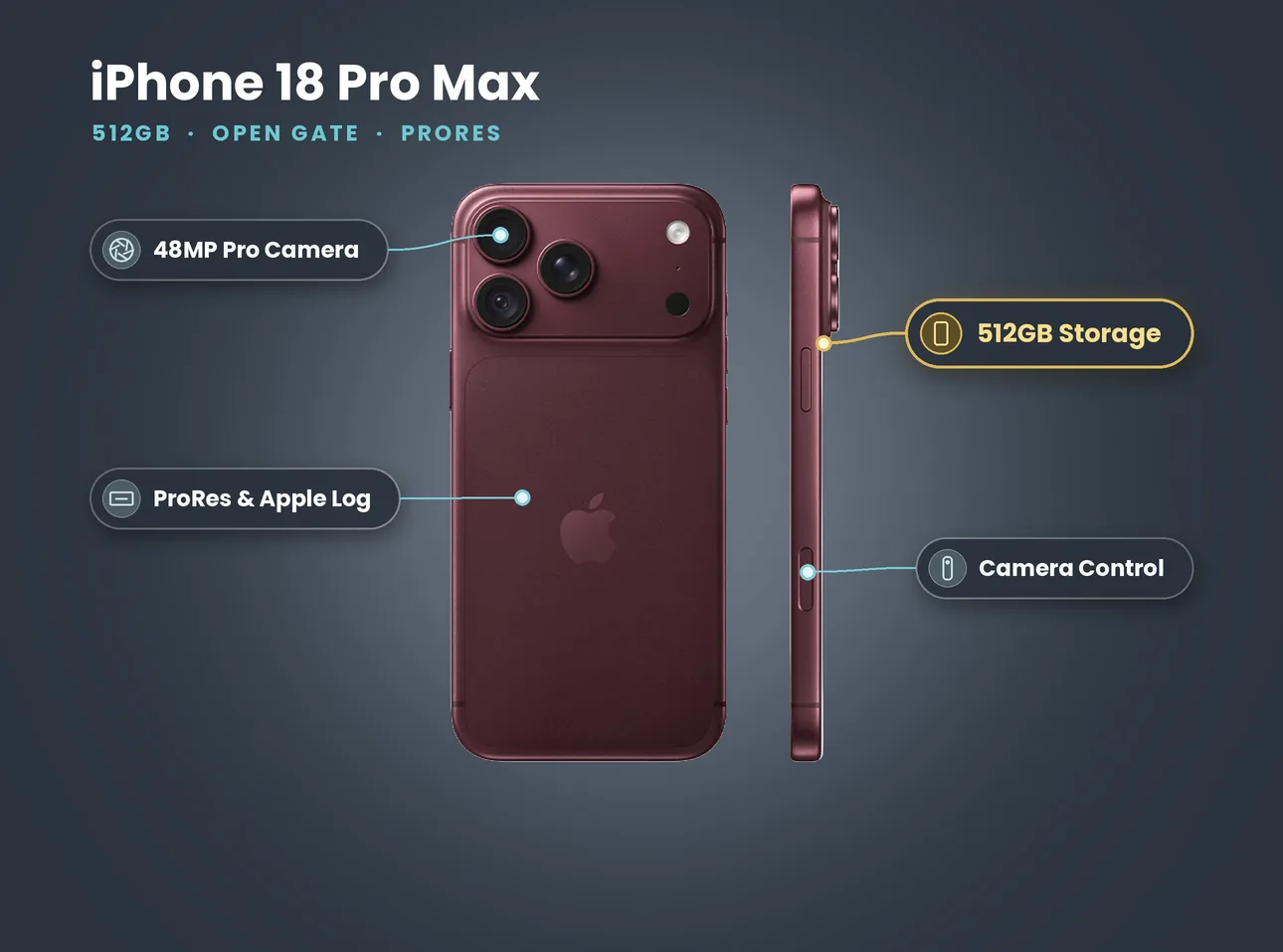
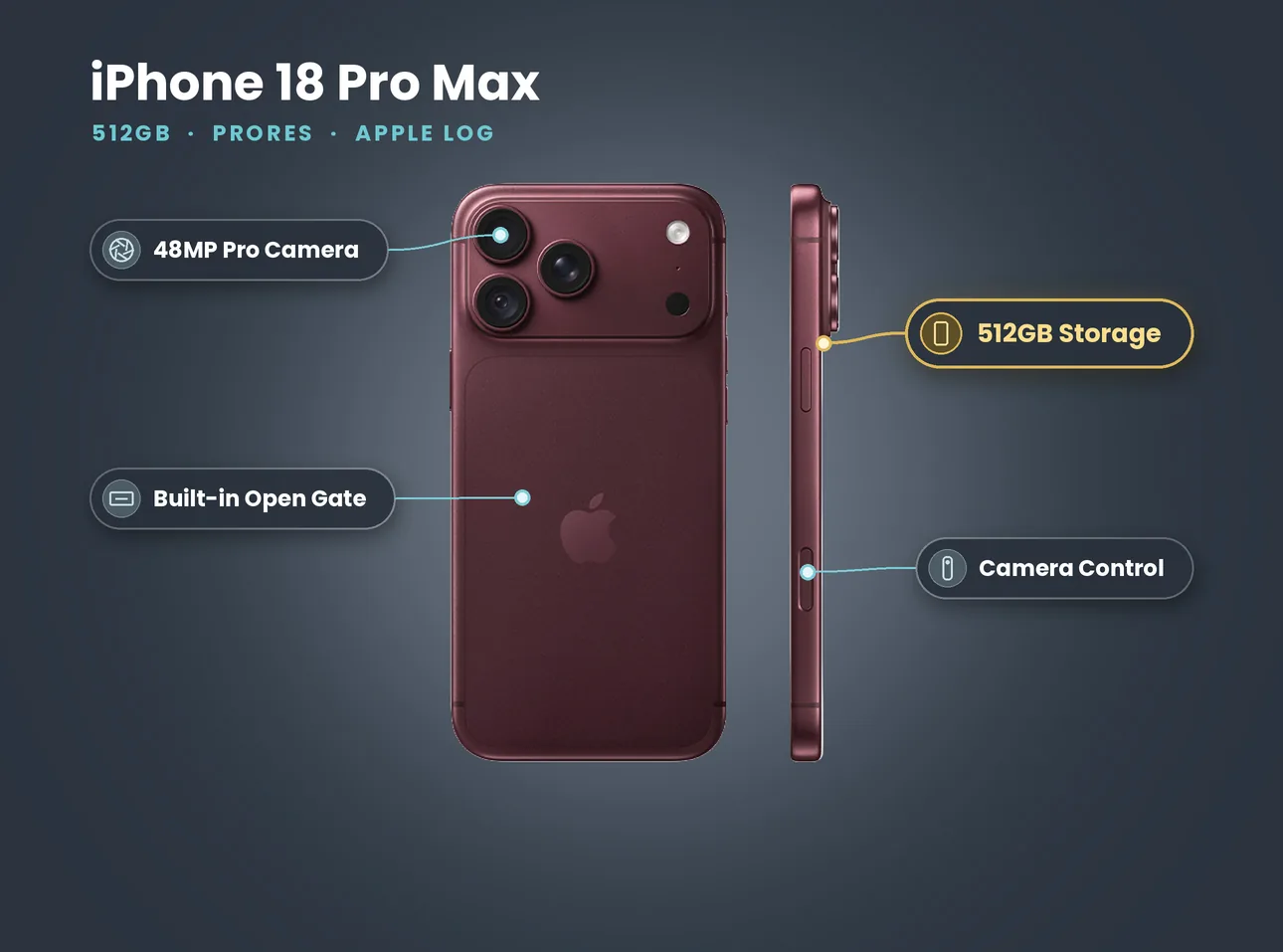
It is the question we hear most at pickup in Soho: "Is the Max better for video?" The answer surprises people. For the image itself, it makes no difference. The iPhone 18 Pro and the iPhone 18 Pro Max carry the same camera system, the same sensors, the same codecs and the same frame rates. What changes is everything around the camera: weight, screen size, battery and the storage tiers we stock.
So the real question is not which phone shoots better. It is which body suits the way you are going to shoot. This guide puts the specs side by side, then works through the job types we see most and tells you which one we would rent for each, with live prices from our own listings.
- Same image: both phones have Apple's 48MP Pro Fusion camera system, ProRes, Apple Log 2 and 4K up to 120 fps.
- Rent the iPhone 18 Pro (211 g) for gimbals, multi-cam setups and light handheld rigs.
- Rent the iPhone 18 Pro Max (249 g, 6.9 inch screen, up to 43 hours video playback) for cage rigs, long ProRes days and when the phone is your monitor.
- Prices on 27 October 2026: Pro Max 512GB from £84 a day; iPhone 18 Pro 256GB creator kit £100 a day. No deposit on these kits.
In this guide
The cameras are identical
Start with what does not change, because it clears up most of the confusion. On Apple's iPhone 18 Pro tech specs page, both models share one column for the camera. Both have:
- a 48MP Fusion Main camera at 24mm with a variable aperture of f/1.48, f/1.8, f/2.8 and f/4.0
- an optical-quality 2x at 48mm, taken from the main sensor
- a 48MP Fusion Ultra Wide at 13mm, f/2.2
- a 48MP Fusion Telephoto at 100mm (4x), f/2.8, plus an optical-quality 8x at 200mm
- 4K Dolby Vision at 24, 25, 30, 60, 100 and 120 fps
- ProRes up to 4K at 120 fps with external recording, ProRes RAW in compatible apps, and Apple Log 2
- four studio-quality microphones with wind noise reduction and Audio Mix
If you graded a clip from each phone side by side, you would not be able to tell which was which. We have done exactly that on test shoots, and hunting for a difference is a waste of a morning. So ignore any advice that says "get the Max for better video". Choose on handling.
Side by side: the specs that actually differ
Here is everything that matters for a shoot, taken from Apple's specs and Apple's UK store on 27 October 2026, plus what we stock.
| iPhone 18 Pro | iPhone 18 Pro Max | |
|---|---|---|
| Camera system | 48MP Pro Fusion, identical | 48MP Pro Fusion, identical |
| Display | 6.3 inch, 2622 x 1206 | 6.9 inch, 2868 x 1320 |
| Weight | 211 g | 249 g |
| Video playback (Apple figure) | up to 34 hours | up to 43 hours |
| Apple UK price, 256GB | £1,199 | £1,299 |
| Apple UK price, 512GB | £1,399 | £1,499 |
| What we rent | 256GB, mostly in kits | 512GB, on its own and in kits |
| Cheapest LighRent option | Creator kit, £100 a day | Phone only, £84 a day |
Three rows deserve a closer look.
Weight. 38 g sounds like nothing. On a gimbal, or held at arm's length for a two minute walking shot, it is the difference between a smooth move and a shaky last ten seconds. On a tripod or in a cage with two handles, you will not notice it.
Battery. Apple quotes 43 hours of video playback for the Pro Max against 34 for the Pro. Recording 4K with the screen bright drains much faster than playback, so treat those numbers as a ratio, not a promise. In practice the Pro Max gets you through an extra chunk of a shoot day before you reach for a power bank.
Screen. The phone is your monitor. On the Pro Max you get 6.9 inches to judge focus, read the histogram in a third-party camera app and show the artist playback. That matters more than most people expect, especially outdoors in daylight.
Storage: 256GB vs 512GB on a real shoot
This is the difference that catches people out. We stock the iPhone 18 Pro at 256GB and the Pro Max at 512GB, and if you shoot ProRes, storage decides your day more than anything else in this comparison.
These are the real data rates we measured on our own footage from the iPhone 18 Pro:
| Codec | Real data rate | About per minute |
|---|---|---|
| HEVC 4K 25 fps, 10-bit HDR | about 42 Mb/s | 0.3 GB |
| ProRes HQ 4K 25 fps | about 670 Mb/s | 5 GB |
| ProRes HQ 4K 60 fps, Apple Log | about 1.5 Gb/s | 11 GB |
Apple's ProRes support page also asks you to keep at least 10% of the phone's storage free to record ProRes. Do that maths on a phone that already holds iOS and apps, and you get roughly:
- 256GB iPhone 18 Pro: around half an hour of ProRes HQ 4K25, or a few minutes of 4K60 Log
- 512GB iPhone 18 Pro Max: well over an hour of ProRes HQ 4K25
HEVC is a different story. At about 0.3 GB a minute, either phone holds many hours. For most social content, HEVC in HDR is what we shoot anyway, and we keep ProRes for the shots that need heavy grading.
If you want ProRes all day on the 18 Pro, you are not stuck: plug a fast SSD into the USB-C port. Apple's ProRes 4K120 mode only works with external recording, and our iPhone open gate recording guide explains the drive rules in detail.
What's in the kits we compare in this guide:
- iPhone 18 Pro Max 512GB: phone and USB-C cable. £84 a day, £250 for 3 days, £488 for 7 days.
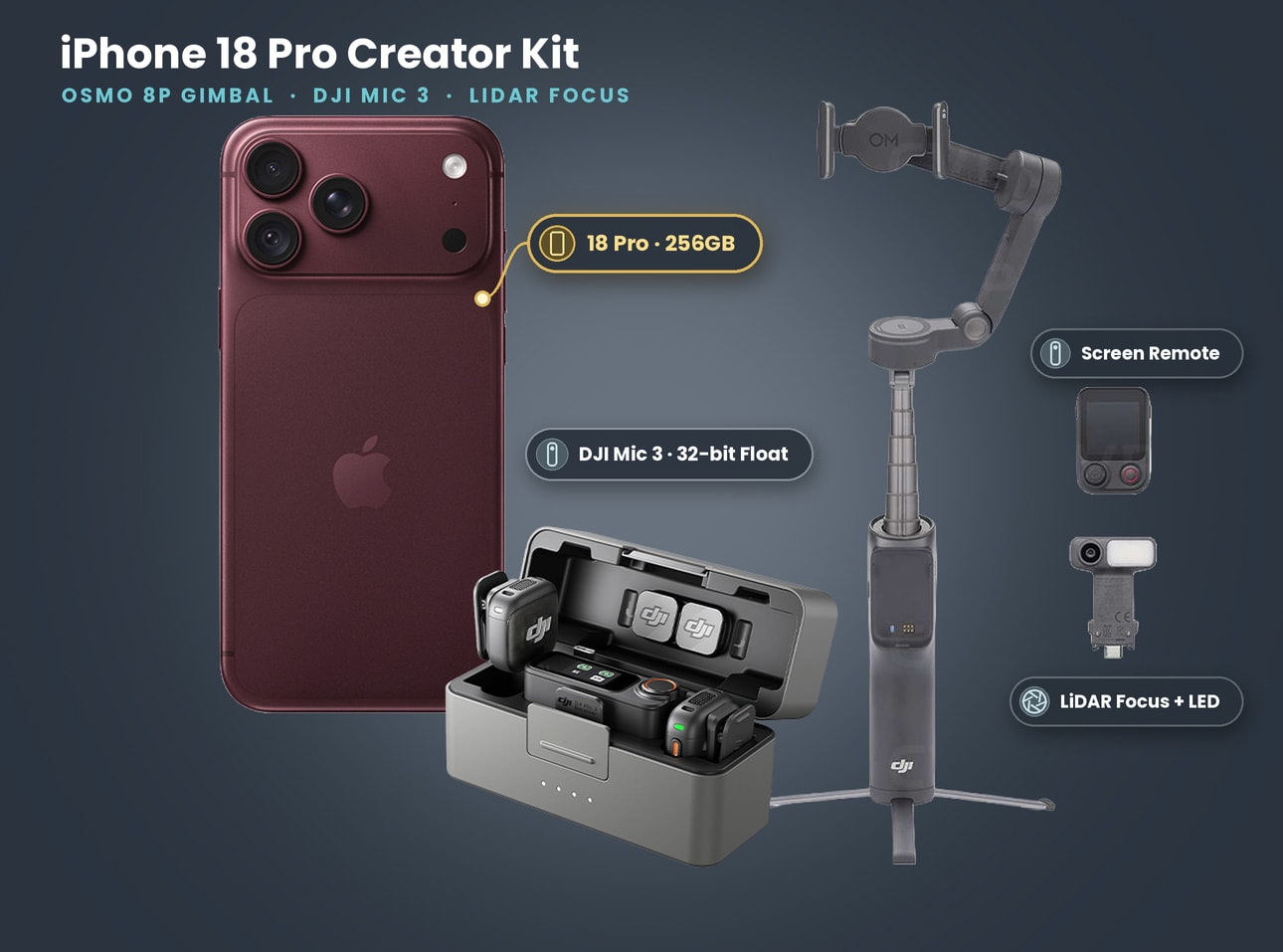
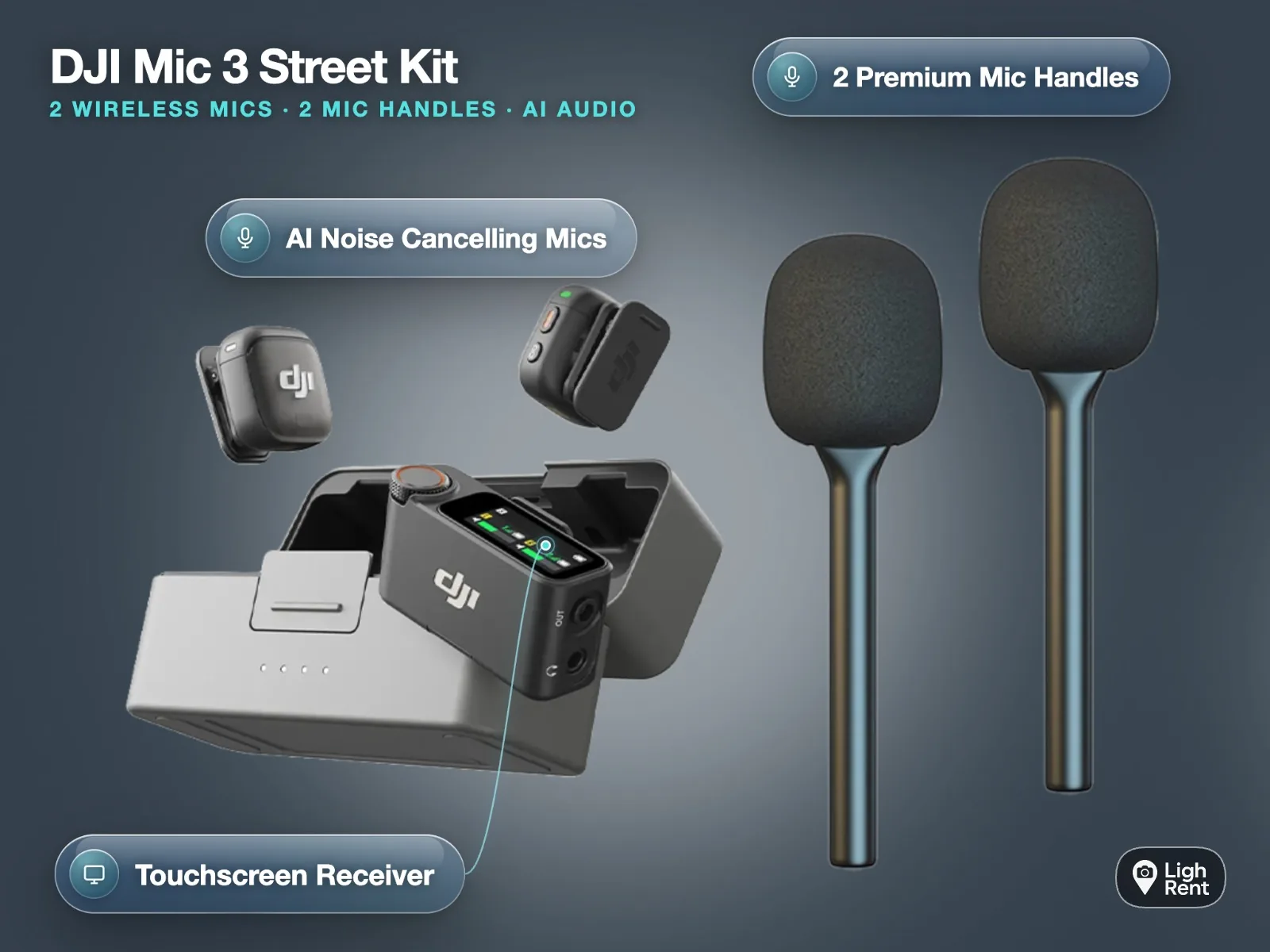
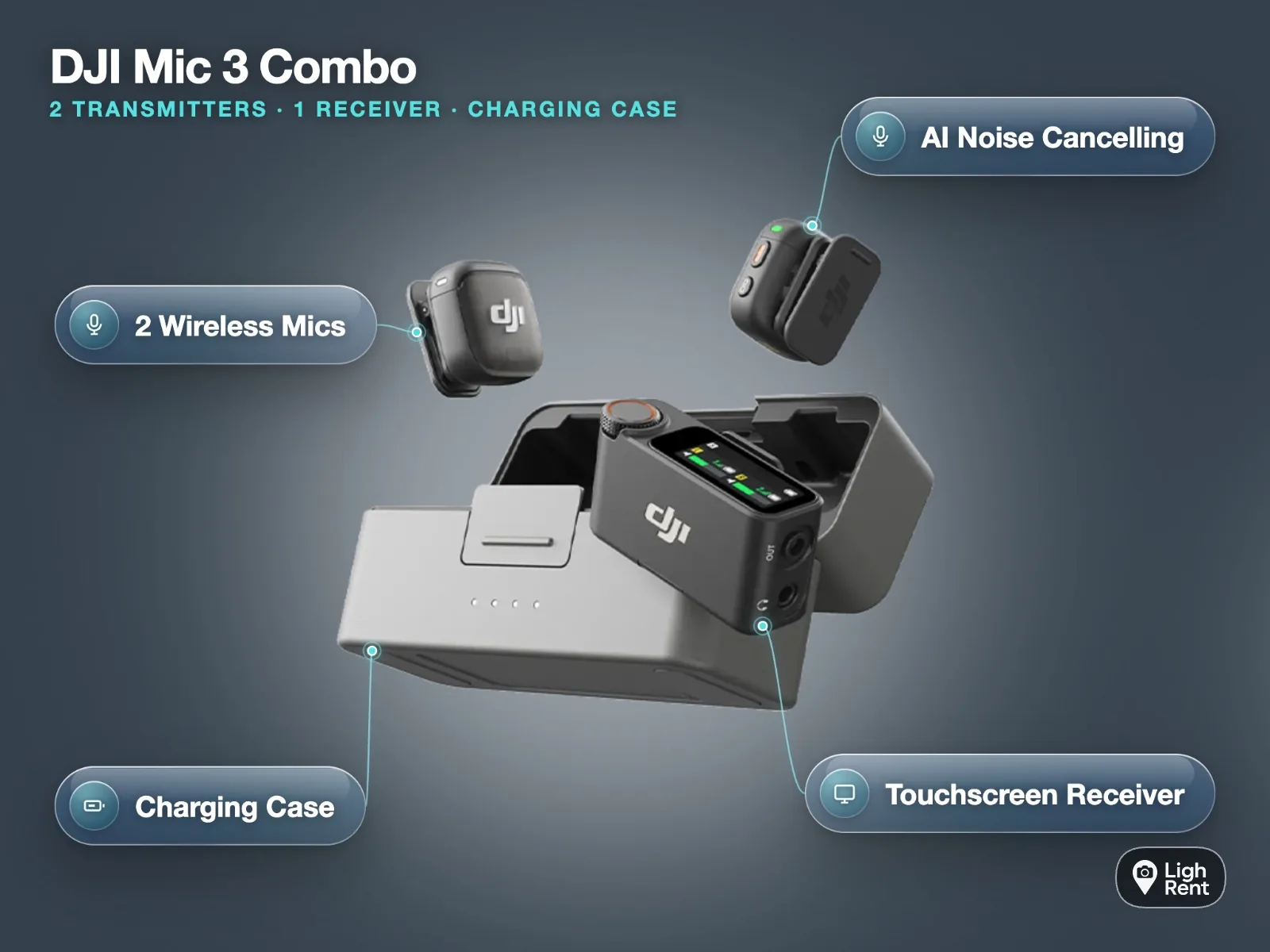
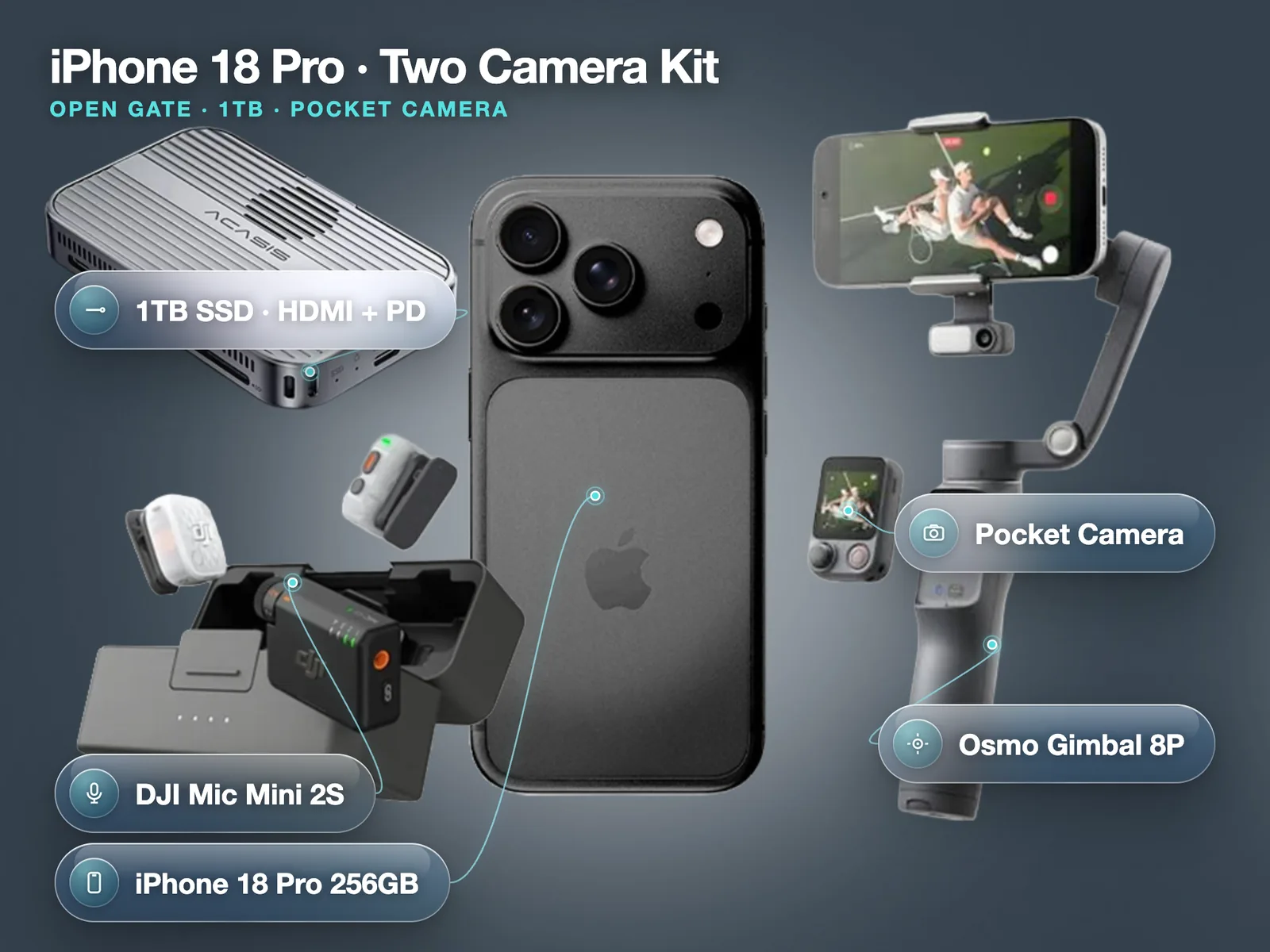
- iPhone 18 Pro 256GB + DJI Gimbal Osmo 8P + DJI Mic 3: £100 a day, £280 for 3 days, £628 for 7 days.
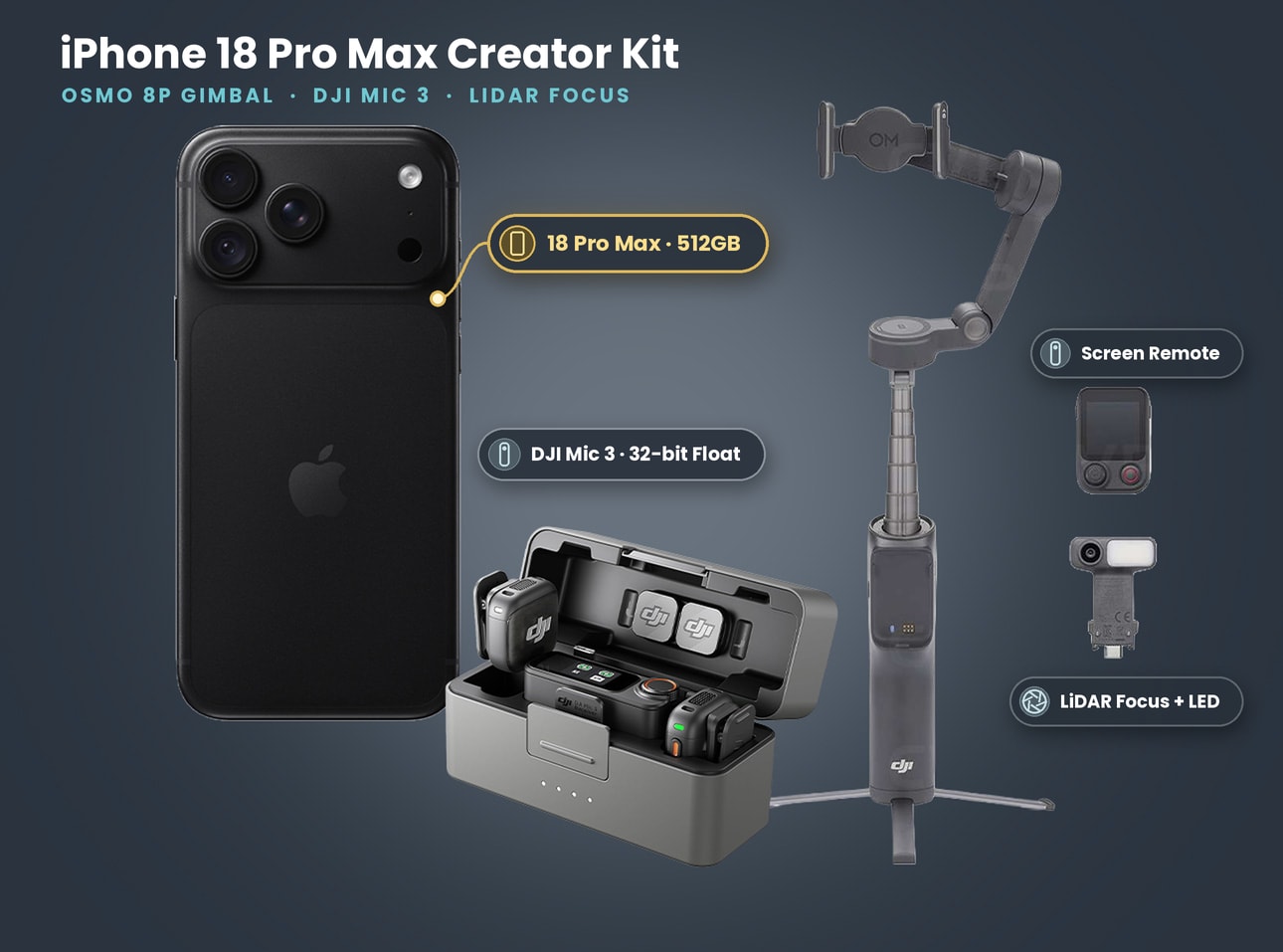
- iPhone 18 Pro Max 512GB + DJI Gimbal Osmo 8P + DJI Mic 3: £125 a day, £320 for 3 days, £680 for 7 days.
Prices on 27 October 2026. No deposit on these kits. ID verification on every booking. Collect from Soho, Bethnal Green or Finsbury Park.
Which one to rent for your job
We look at the shot list first, then the phone. Here is how we match them.
Gimbal work: rent the iPhone 18 Pro
The DJI Gimbal Osmo 8P takes phones from 170 to 300 g, according to DJI's own specs, so both iPhones fit. But the 211 g Pro balances faster and the motors work less, which shows on fast pans and long walking shots. On a three hour run-and-gun shoot, the lighter phone also means a less tired operator.
The gimbal's 1.4 inch FrameTap remote mirrors the phone's view, so the smaller screen on the Pro matters less when you operate from a distance. That is why our creator kit for the 18 Pro pairs it with the Osmo 8P and a DJI Mic 3.
Cage rigs, ND and LED: rent the iPhone 18 Pro Max
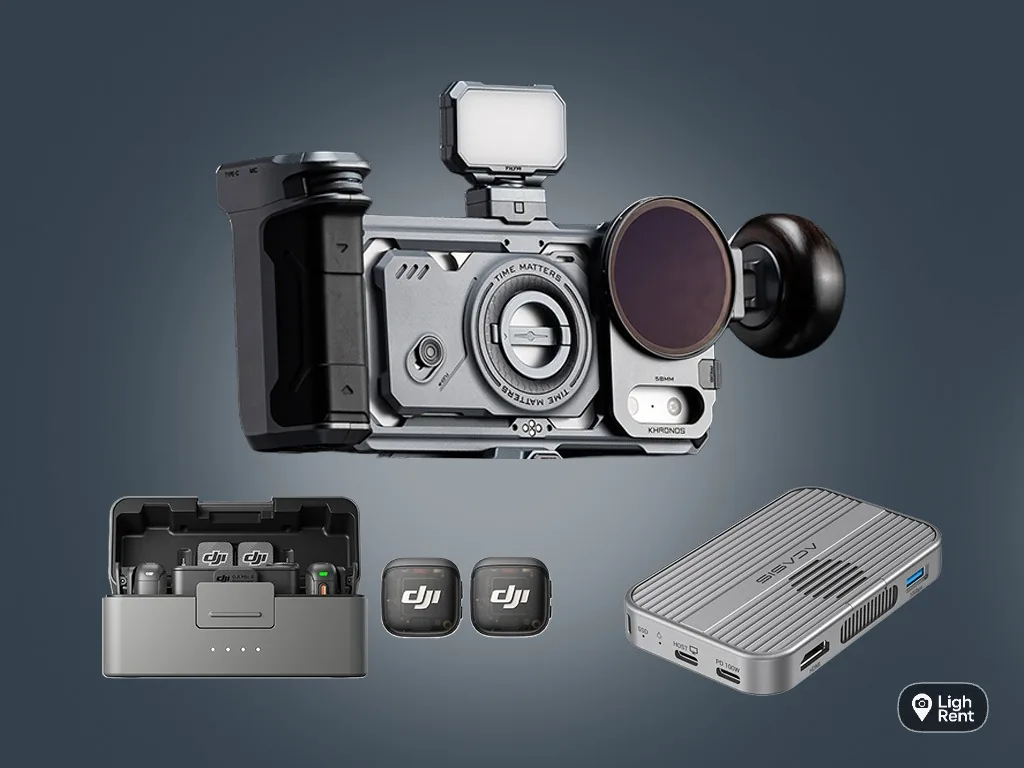
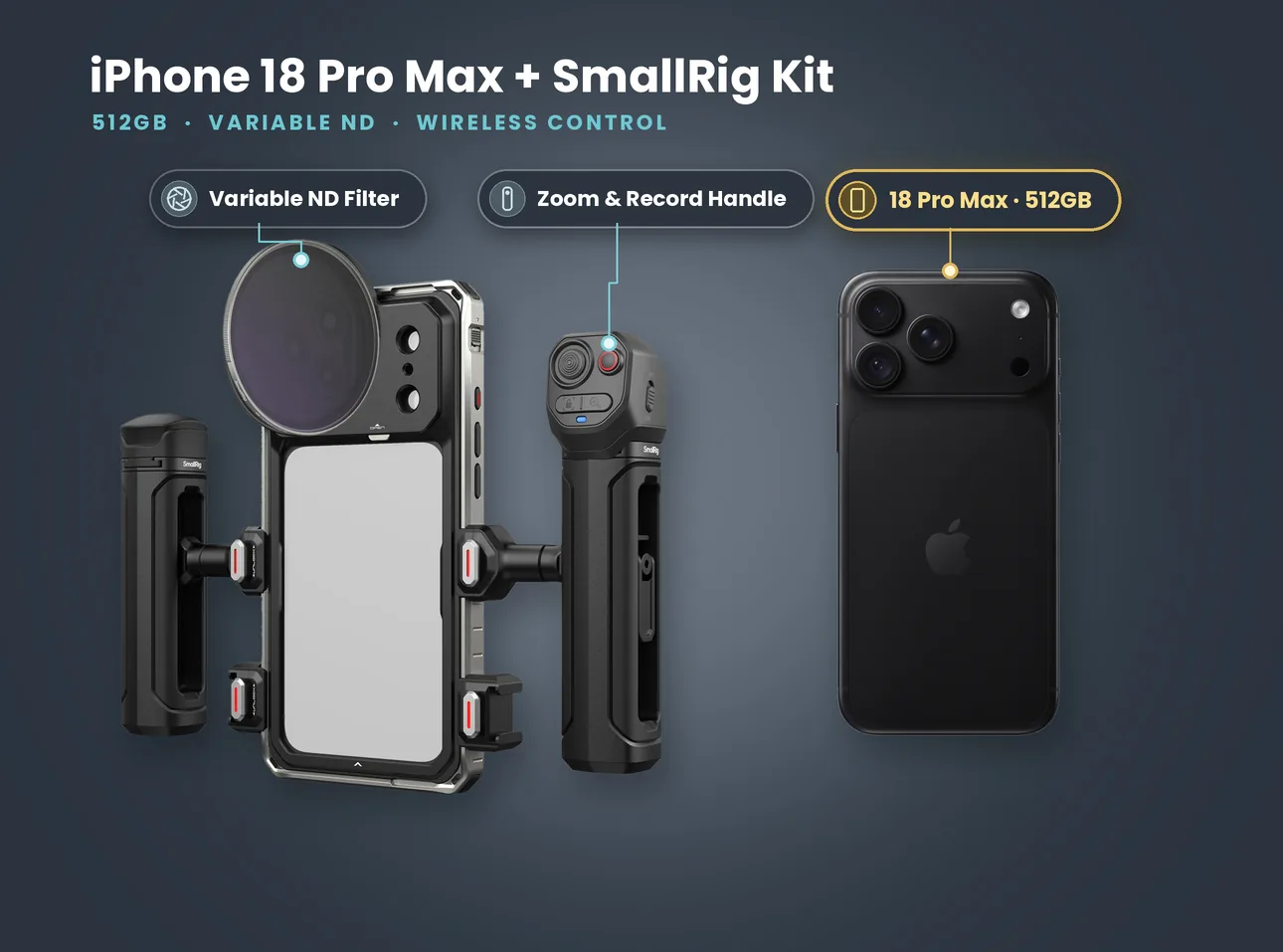
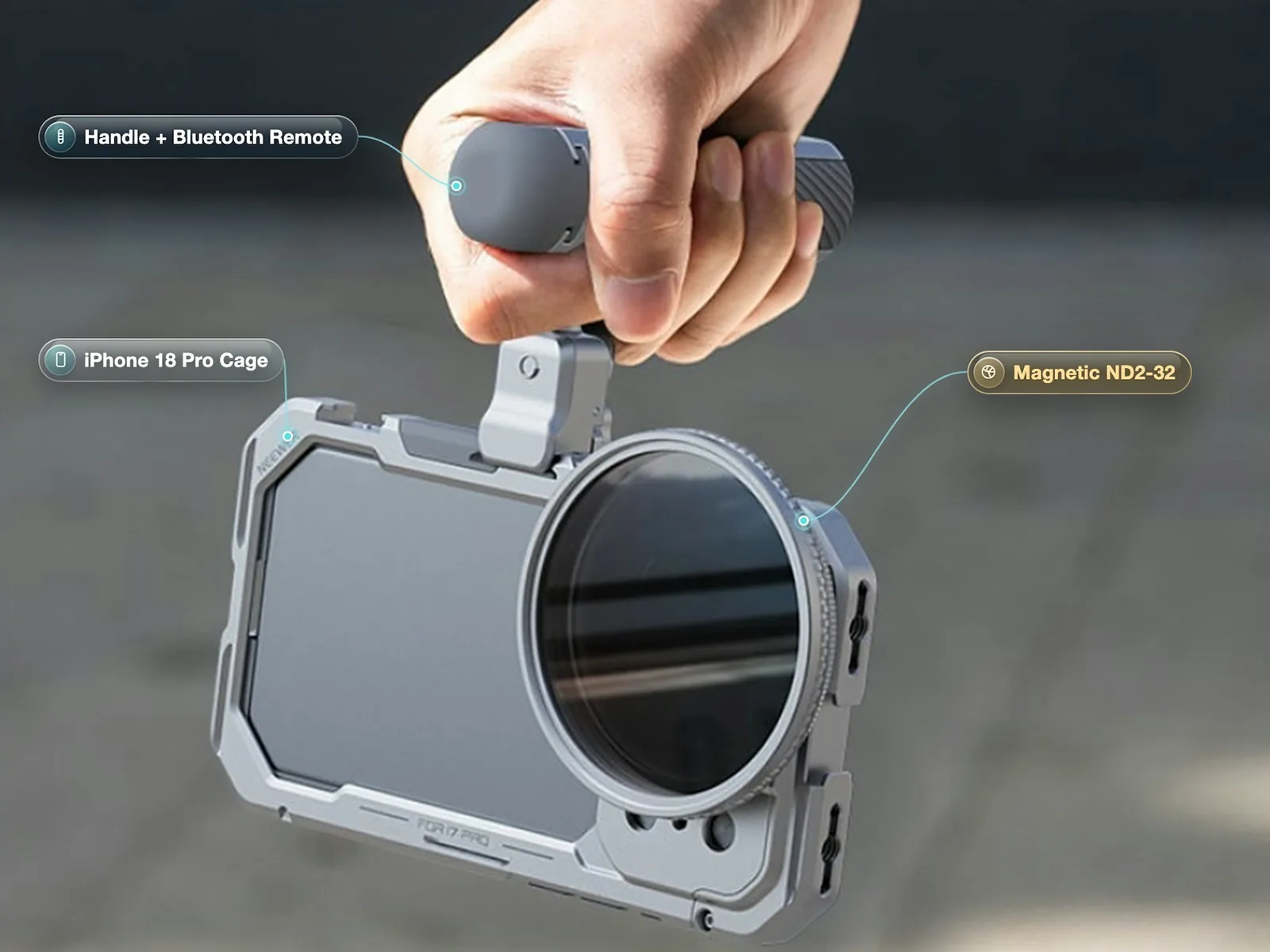
Once a phone sits in a cage with two handles, a variable ND and an LED on top, its weight disappears into the rig. What you notice instead is the screen. The 6.9 inch display is the closest thing to a field monitor on a phone, and on a bright day with ND on, you will want every bit of it. The bigger battery helps too, because a cage rig usually means a longer, more planned shoot.
Long ProRes or Log days: rent the iPhone 18 Pro Max (or add an SSD)
If the brief says "shoot everything in ProRes Log for the grade", start with the 512GB Pro Max. You will still want an SSD for anything above about an hour of ProRes HQ, but you get far more room before you have to offload. If you need the lighter phone for movement, take the Pro and plan your SSD and offloads from the start.
Multi-cam: rent matching iPhone 18 Pros
For a podcast, an interview from two angles or a performance with a wide and a tight, the cameras must match. Because the Pro and Pro Max share the same cameras, you could mix them, but we prefer identical phones so the screens, battery life and handling are the same for every operator. We rent an iPhone 18 Pro two camera kit at £120 a day (£672 for 7 days) and a set of three iPhone 18 Pros at £300 a day (£1,680 for 7 days).
Set every phone the same before you roll: same app, same resolution, same frame rate, same shutter, same white balance. Then clap on camera or use timecode so the edit lines up in seconds rather than an hour.
Interviews and vox pops: either, with a good mic
For a sit-down interview on a tripod, the phone choice barely matters. Sound does. Put the money into a wireless mic and a second angle. If the interview is handheld on the street, go for the Pro and a gimbal.
Travel and long days on foot: rent the iPhone 18 Pro
If you are walking a city all day or shooting from a bike, every gram counts. The Pro also fits in a jacket pocket between setups, which sounds trivial until you are standing in the rain waiting for the next take.
Not sure which phone fits your shot list? Book the kit that matches your main setup and we will talk you through it at pickup. Book the iPhone 18 Pro creator kit
Quick decision table
| Your shoot | Rent | Why |
|---|---|---|
| Gimbal walk and talk | iPhone 18 Pro | lighter, faster balance, less fatigue |
| Music video in a cage rig | iPhone 18 Pro Max | bigger monitor, more battery |
| Full day ProRes Log | iPhone 18 Pro Max + SSD | 512GB plus external recording |
| Two or three camera podcast | Matching iPhone 18 Pros | identical handling and settings |
| Street interviews | iPhone 18 Pro + gimbal + Mic 3 | light, quick to move |
| Product or table top | either | phone on a tripod, screen size is a bonus |
| Slow motion 4K 120 | either | both shoot 4K Dolby Vision at 120 fps |
Mistakes we see at pickup
These come from returns and phone calls, not theory.
- Booking the Pro Max "for the camera". You pay more for a bigger body you then struggle to balance on a gimbal. Rent for handling, not image.
- Shooting ProRes on a near-full phone. Apple needs 10% free space for ProRes. If the phone is close to full, ProRes will not record. Offload first, or switch to HEVC.
- Mixing settings on multi-cam. One phone at 25 fps and another at 30 fps gives you a headache in the edit. Lock the frame rate on every phone before the first take.
- Forgetting the phone gets hot. In direct sun and with long 4K recording, the phone may dim the screen to protect itself. Shade it, use a rig with a fan if you have one, and keep spare power.
- No plan for storage. Decide before the shoot which shots are ProRes and which are HEVC. The real numbers above make the maths easy.
Settings we use on both phones
The settings do not change between the two models, which makes life simple when you mix them.
- Frame rate: 25 fps for UK content and anything that might be broadcast; 24 fps for a film feel when there is no flicker risk from lights; 50 or 60 fps for action you may slow down; 120 fps for proper slow motion.
- Shutter: around double your frame rate (1/50 at 25 fps) for natural motion blur. You need a third-party app like the free Blackmagic Camera app to lock shutter speed or shutter angle, and a variable ND to keep it there in daylight.
- Codec: HEVC 4K HDR for most social work; ProRes HQ for shots that will be graded hard; Apple Log 2 only when you have time to grade properly.
- Exposure: expose for faces, and check false colour or zebras in the Blackmagic app rather than trusting the phone's screen brightness.
- Audio: use an external wireless mic for speech, and keep the phone's own microphones as a backup track.
Rent, compare, then decide
If you are torn, the cheapest way to settle it is to try both. The Pro Max 512GB on its own is £84 a day, and our 18 Pro kits come with the gimbal and mic already included, which you would want anyway for most handheld work. If you are thinking about buying instead, Apple's UK store lists the 18 Pro 256GB at £1,199 and the Pro Max 512GB at £1,499 on 27 October 2026. Our renting vs buying maths shows when owning starts to make sense.
Booking takes a few minutes: send a request, verify your ID, then collect. Our how booking works page covers each step. Collect from Soho, Bethnal Green or Finsbury Park.
Need the big screen and the long battery? Rent the iPhone 18 Pro Max 512GB on its own or build a rig around it. Book the iPhone 18 Pro Max 512GB
- iPhone open gate recording: how to record the full sensor and when you need an SSD
- iPhone gimbal hire with the DJI Gimbal Osmo 8P: balancing, tracking and settings for smooth handheld video
- The best iPhone music video rig: cage, ND, LED and power set-ups that work on set
- Renting vs buying an iPhone for a shoot: the cost maths with real prices