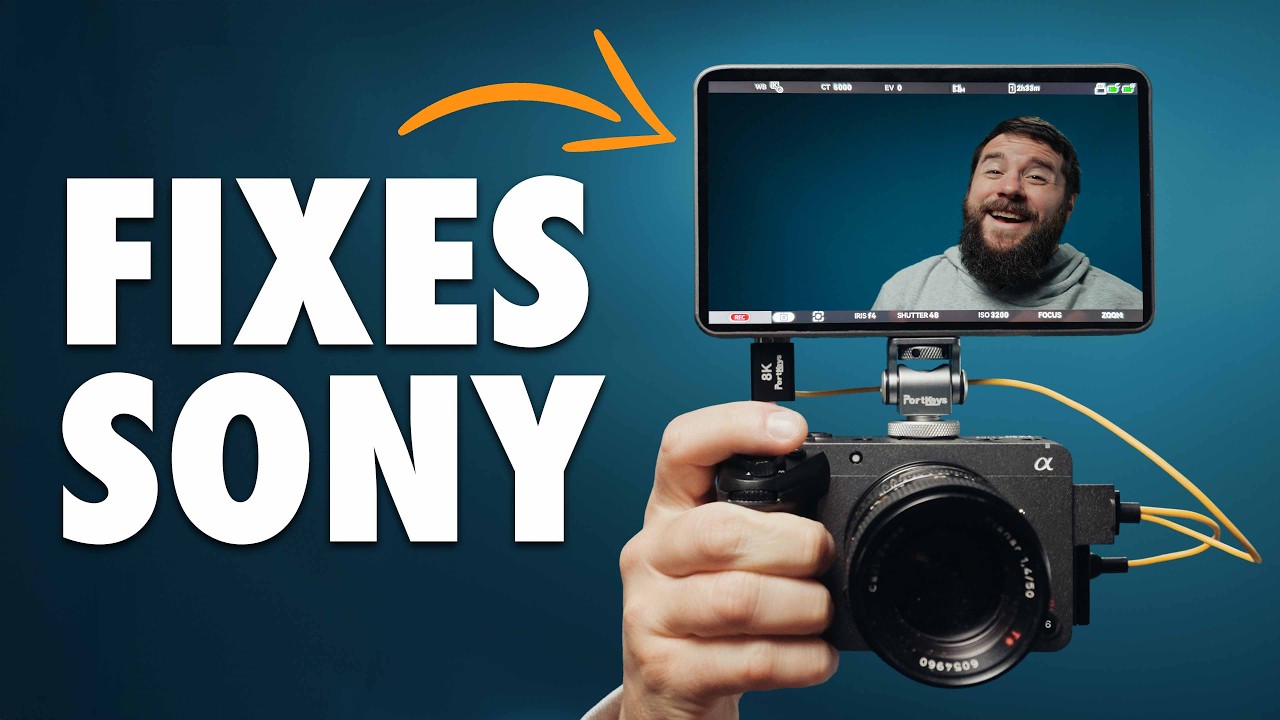
TL;DR
- The Portkeys LH7C is a 7-inch touchscreen field monitor that directly addresses Sony cameras' lack of a large, color-accurate external display - a pain point every Sony shooter knows intimately.
- At under $400 USD, it punches well above its price class with a 2000-nit panel, 3D LUT support, waveform, vectorscope, and false color - tools previously locked behind monitors costing three times as much.
- It pairs especially well with Sony mirrorless and cinema cameras, giving you accurate exposure monitoring and professional on-set confidence without breaking your budget.
- You do not need to buy one outright - Dubai-based filmmakers can rent the Portkeys LH7C and complementary Sony gear through LighRent's camera accessories category and test it before committing to a purchase.
- Renting before buying is the smartest move for a monitor at this price point - workflow compatibility, colour science matching, and mount options all need real-world testing.
If you have ever shot on a Sony mirrorless camera - whether that is an A7S III, FX3, FX6, or even the powerhouse A7R V - you already know the frustration. Sony builds exceptional sensors, remarkable dynamic range, and industry-leading autofocus systems. What they have never quite nailed is giving you a monitoring solution that matches the quality of what those sensors are actually capturing. The rear LCD is small, the electronic viewfinder gets washed out in Dubai's brutal sunlight, and the built-in histogram, while functional, is no substitute for a proper broadcast-grade monitoring suite. Enter the Portkeys LH7C - a field monitor that has quietly become one of the most talked-about accessories in the independent filmmaking community, and for very good reason.
This article is for Dubai and UAE-based content creators, videographers, and documentary filmmakers who are serious about their craft but equally serious about their budget. Whether you are shooting a commercial in Downtown Dubai, a travel film across the Emirates, or a short narrative in the Al Quoz creative district, the Portkeys LH7C might be the single accessory upgrade that transforms your on-set experience. And if you want to try it before you buy it, LighRent - Dubai's peer-to-peer camera rental marketplace - is the smartest way to get hands-on with professional monitoring gear without a four-figure commitment.
Let's break down exactly what the LH7C does, why it matters specifically for Sony shooters, how it stacks up against the competition, and what a rental-first strategy looks like for filmmakers working in the UAE.
Sony's Monitoring Problem - And Why It Has Persisted
To understand why a monitor like the Portkeys LH7C matters so much, you need to understand the specific gap it fills in the Sony ecosystem. Sony's mirrorless and cinema cameras are arguably the most popular professional video tools in the world right now. The FX3 is a staple on UAE commercial sets. The A7S III is the low-light king for event videographers across Dubai. Yet both cameras share a fundamental limitation: their built-in screens are too small, too reflective, and too colour-inaccurate for serious professional monitoring work.
Professional cinematographers rely on tools like false colour to nail exposure - a visual overlay that colour-codes different exposure levels across your frame so you can immediately see if your subject's skin tones are riding perfectly in the mid-tones or if your highlights are clipping. Sony's internal false colour implementation exists on some models but is buried in menus and displayed on a 3-inch screen that becomes nearly invisible in midday UAE sunlight. Waveform monitors, vectorscopes, and peaking tools are similarly compromised by the display size. This is not a criticism of Sony's engineering - it is simply a hardware constraint of a compact mirrorless body.
The professional solution has always been an external field monitor. The problem? Monitors from SmallHD, Atomos, and Convergent Design that offer the full suite of professional tools have historically cost between AED 2,500 and AED 8,000 or more. That is a significant investment on top of a body that may already have cost you AED 12,000 to AED 20,000. The Portkeys LH7C changes this calculation entirely - and if you shoot on any Sony Rental on LighRent, pairing it with a proper field monitor should be the very first thing on your accessories checklist.
Portkeys LH7C: Full Specification Breakdown
Before we get into real-world performance, let's establish exactly what the Portkeys LH7C offers on paper. These are the specifications that matter to working filmmakers - not marketing language, but the actual numbers that determine whether a monitor belongs on a professional set.
| Specification | Portkeys LH7C | SmallHD Focus 7 | Atomos Shinobi 7 |
|---|---|---|---|
| Panel Size | 7 inch IPS | 7 inch IPS | 7 inch IPS |
| Resolution | 1920 x 1200 | 1920 x 1200 | 1920 x 1200 |
| Peak Brightness | 2000 nits | 1800 nits | 1000 nits |
| 3D LUT Support | Yes (up to 33-point) | Yes | Yes |
| Touchscreen | Yes | Yes | No |
| Waveform / Vectorscope | Yes | Yes | Yes |
| False Colour | Yes | Yes | Yes |
| HDMI Input | Full HDMI + Micro HDMI | Full HDMI | Full HDMI + Micro HDMI |
| Power Input | V-Mount / NP-F / USB-C | L-Series / USB-C | NP-F / D-Tap / USB-C |
| Approximate Price (USD) | ~$380 | ~$749 | ~$499 |
The numbers tell a compelling story. The LH7C outperforms the Atomos Shinobi 7 in brightness - a crucial advantage when you are shooting in direct sunlight on a rooftop in Dubai Marina or at an outdoor event in Abu Dhabi. It matches the SmallHD Focus 7 in almost every professional feature category at roughly half the price. The dual HDMI input configuration (full-size and micro) gives it maximum compatibility across Sony's mirrorless lineup without adapters.
The Power System - Why This Matters More Than You Think
One of the LH7C's most underrated features is its flexible power system. It accepts V-mount batteries, Sony NP-F style batteries, and USB-C power delivery. This is enormously practical on a UAE production where you might be running multiple pieces of gear simultaneously. If you are already carrying V Mount / V Lock Batteries (×2 batteries + ×2 V-mount plates) for your lights or wireless transmitters, the same battery ecosystem powers your monitor - reducing the number of separate charging systems you need to manage on location.
For run-and-gun documentary shooters working across the UAE, this battery flexibility can genuinely be the difference between a smooth shoot day and a logistical nightmare.
Real-World Performance for Sony Shooters in the UAE
Specifications only matter in the context of real-world use. Let's talk about what the LH7C actually does for a Sony shooter working in Dubai's specific conditions.
Sunlight Readability at 2000 Nits
Dubai's ambient light conditions are among the most demanding in the world for display technology. Between April and October, direct sunlight can render even a 1000-nit display nearly unreadable at certain angles. At 2000 nits, the LH7C is genuinely usable in full sun - not just marginally readable, but actually useful for critical focus checking and exposure decisions. This is a game-changer if you regularly shoot outdoor interviews, automotive content, or lifestyle campaigns in the UAE.
S-Log3 and S-Cinetone Monitoring with 3D LUTs
Sony's most capable cameras shoot in S-Log3 or S-Cinetone colour profiles - flat, washed-out images that preserve maximum dynamic range for colour grading in post. The challenge on set is that a flat log image is deeply unintuitive to monitor. Skin tones look grey, skies look milky, and it is nearly impossible to make confident creative decisions without converting that log signal to something resembling a final grade.
The LH7C's 3D LUT support allows you to load a Sony S-Log3-to-Rec709 conversion LUT directly onto the monitor, so you see a graded, natural-looking image on screen while your camera records the flat, maximally-detailed log file. This workflow - standard on high-end productions - is now accessible to any filmmaker who rents or owns this monitor. You can download free Sony-specific conversion LUTs directly from Sony's official resource library and load them onto the LH7C via its SD card slot.
Focus Assist Tools That Sony's Own Screen Cannot Provide
Sony's peaking focus assist is functional but limited on a 3-inch screen. On a 7-inch 1920x1200 display with the LH7C's enhanced peaking, zoom-to-focus, and edge detection tools, pulling critical focus becomes dramatically more reliable - especially important when shooting wide-open on a fast prime where your depth of field might be measured in centimetres. This is particularly relevant if you are working with the Sony A7R V + Sony FE 24-70mm F 2.8GM - 8K Power Setup, where the resolution ceiling means that any focus error will be mercilessly exposed in post.
"A field monitor is not a luxury on a professional