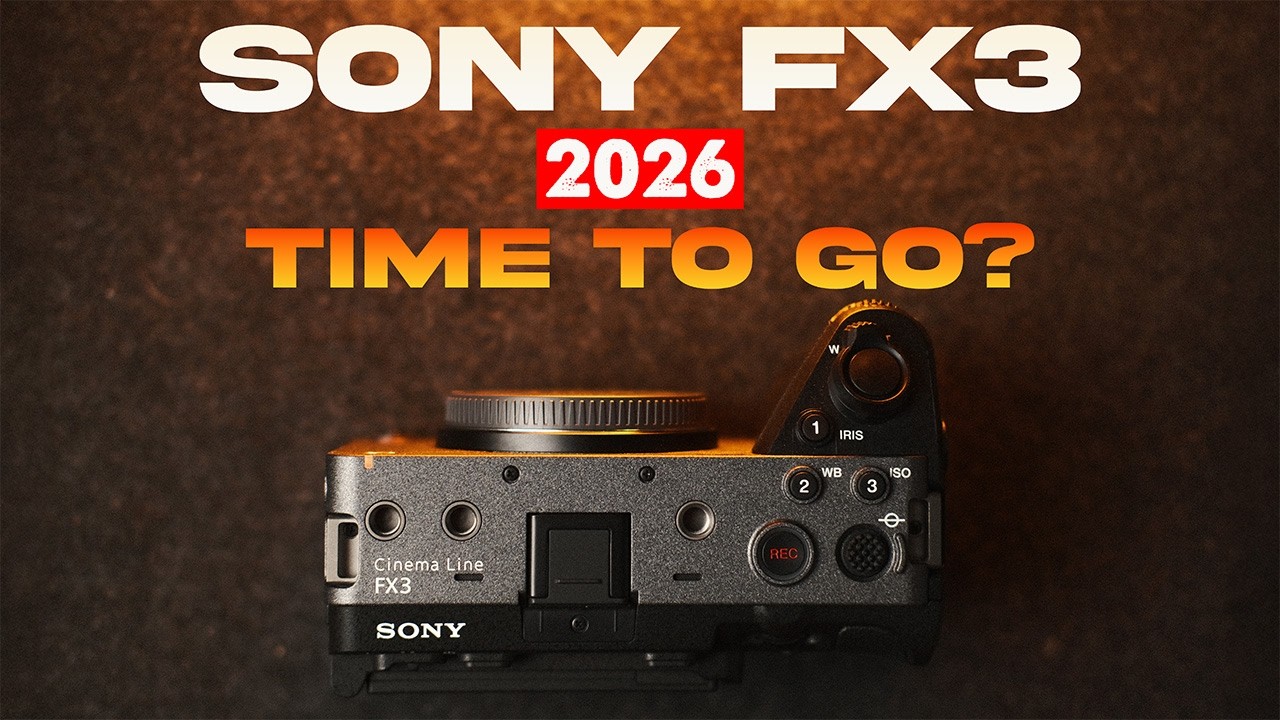
TL;DR
- The Sony FX3 remains highly relevant in 2026 with exceptional image quality and professional features that rival newer cameras
- While newer models offer incremental improvements, the FX3's proven reliability and extensive lens ecosystem keep it competitive
- Rental prices have become more accessible as newer models enter the market, making it an excellent value proposition
- The FX3 excels in documentary work, corporate videos, and hybrid shooting scenarios where size and image quality matter
- Consider renting before buying to test compatibility with your workflow and assess whether newer alternatives suit your needs better
As we navigate through 2026, the question on every filmmaker's mind isn't whether the Sony FX3 is still a capable camera - it's whether this once-revolutionary full-frame cinema camera has finally been overtaken by technological progress. Released in early 2021, the FX3 carved out a unique niche as Sony's most compact cinema camera, bridging the gap between their Alpha series and professional FX lineup.
The landscape has shifted dramatically since the FX3's debut. New contenders have emerged, sensor technology has advanced, and shooting preferences have evolved. Yet, seasoned professionals continue reaching for the FX3 on shoots across the UAE, suggesting there's more to this story than simple spec comparisons. Whether you're considering adding one to your kit or exploring rental options through LighRent, understanding the FX3's current position requires examining both its enduring strengths and emerging limitations.
The answer isn't straightforward - camera obsolescence rarely follows predictable timelines in professional contexts where reliability, workflow integration, and proven performance often outweigh cutting-edge specifications.
Current Market Position: Where the FX3 Stands in 2026
The Sony FX3's market positioning in 2026 represents a fascinating case study in camera longevity. Despite being five years old, the camera continues commanding respect in professional circles, though its dominance has certainly shifted. The introduction of the FX30, FX6 Mark II, and third-party competitors has created a more crowded landscape where the FX3 must justify its place.
Pricing Evolution and Value Proposition
One of the most significant changes has been the FX3's pricing trajectory. Originally launched at AED 17,900, the camera now trades for considerably less on the second-hand market, making it an attractive option for budget-conscious productions. This price reduction has paradoxically increased its appeal, as the cost-to-performance ratio has improved substantially.
For many UAE-based production companies, the reduced pricing has made the FX3 accessible for multi-camera setups where previously only single-camera configurations were economically viable. Professional camera rentals have similarly adjusted, with daily rates becoming more competitive as newer models command premium pricing.
| Aspect | Sony FX3 (2026) | Typical New Camera (2026) | Advantage |
|---|---|---|---|
| Purchase Price | AED 10,100-2,800 (used) | AED 16,100-5,000 | FX3 |
| Daily Rental Rate | AED 370-120 | AED 690-250 | FX3 |
| Lens Ecosystem | Extensive Sony E-mount | Varies by brand | FX3 |
| Firmware Support | Active but slowing | Regular updates | New cameras |
| Resale Value | Stabilised | Depreciating rapidly | FX3 |
Professional Adoption Patterns
Interestingly, professional adoption hasn't followed the typical decline pattern expected of aging technology. Documentary filmmakers, in particular, continue gravitating towards the FX3 for its compact form factor and exceptional low-light performance. The camera's ability to blend into environments while delivering cinema-quality footage remains largely unmatched by bulkier alternatives.
Corporate video production has shown similar loyalty, with many UAE agencies maintaining FX3 kits as their primary workhorses. The camera's reliability record over five years has proven its worth in demanding commercial environments where equipment failure isn't an option.
Technical Capabilities: Still Competitive or Falling Behind?
Examining the FX3's technical specifications in 2026 reveals a complex picture where some capabilities remain industry-leading while others show their age. The camera's full-frame sensor continues delivering exceptional image quality, though the competitive landscape has certainly intensified.
Image Quality and Sensor Performance
The FX3's image quality remains one of its strongest selling points. The full-frame sensor, shared with the A7S III, continues producing remarkably clean footage with impressive dynamic range. In controlled lighting conditions, the difference between FX3 footage and newer cameras often proves negligible to all but the most discerning viewers.
"I've tested every major camera release since the FX3 launched, and while newer models offer incremental improvements, the FX3's image quality foundation is so solid that it rarely becomes the limiting factor in professional productions." - James Morrison, DP and camera rental specialist
Low-light performance, historically the FX3's calling card, remains exceptional by 2026 standards. While newer sensors have closed the gap, the FX3's ability to capture usable footage at ISO 12800 and beyond continues serving documentary and event filmmakers well. This capability becomes particularly valuable when paired with fast prime lenses like the Sony FE 20mm f/1.8 G, creating combinations that excel in challenging lighting scenarios.
Recording Capabilities and Formats
The FX3's recording specifications tell a nuanced story. Its 4K capabilities remain professional-grade, with 10-bit 4:2:2 internal recording providing sufficient quality for most applications. However, the absence of 8K recording - now standard in many competing cameras - does limit its appeal for productions requiring maximum future-proofing.
More significantly, the FX3's codec options, while professional, lack some of the advanced compression technologies found in newer cameras. This limitation becomes apparent in post-production workflows where file sizes and processing requirements can impact efficiency, particularly for smaller production companies managing large volumes of content.
Stabilisation and Handling
The FX3's built-in image stabilisation remains effective, though not class-leading by 2026 standards. When combined with modern gimbal systems like the DJI RS 5 Combo, the camera delivers exceptionally smooth footage. However, newer cameras often achieve comparable results with less additional equipment, potentially simplifying production workflows.
Ergonomically, the FX3's compact design continues earning praise from operators who value discretion and mobility. The camera's form factor remains ideal for documentary work where larger cameras might prove intrusive or impractical.
Workflow Integration and Ecosystem Considerations
Perhaps nowhere is the FX3's maturity more apparent than in workflow integration. Five years of professional use have refined post-production pipelines and established reliable working practices that newer cameras often can't immediately match.
Post-Production Workflow Maturity
The FX3's colour science and file formats have become deeply integrated into professional post-production workflows. Colourists have developed extensive LUT libraries, and editors understand the camera's characteristics intimately. This familiarity translates into faster turnaround times and more predictable results - valuable commodities in commercial production environments.
Software support has similarly matured, with major editing platforms offering optimised playback and processing for FX3 footage. While newer cameras often require updated software versions or additional processing power, the FX3 works seamlessly with established systems, reducing technical overhead and potential compatibility issues.
Lens Ecosystem Advantages
Sony's E-mount lens ecosystem represents one of the FX3's most significant ongoing advantages. The vast selection of native lenses, from compact primes to professional zooms, provides unparalleled flexibility. This ecosystem maturity means that lens selection is rarely a limiting factor, and rental availability through services like Sony equipment rental specialists ensures access to specialized glass when needed.
The ecosystem extends beyond Sony's own offerings to include exceptional third-party options from manufacturers like Sigma, Tamron, and Zeiss. This diversity ensures that the FX3 can adapt to virtually any shooting scenario, from intimate documentaries requiring discrete lenses to commercial productions demanding the highest optical quality.
Accessories and Support Infrastructure
Five years of market presence has created a mature accessory ecosystem around the FX3. Cage systems, monitors, and support rigs have been refined through real-world use, resulting in more elegant and functional solutions than typically available for newer cameras.
Professional service infrastructure has similarly developed, with repair centres understanding the camera's common issues and maintaining parts inventory. This reliability factor becomes increasingly important as production schedules tighten and equipment downtime becomes costly.
Rental vs. Purchase Considerations in 2026
The decision between renting and purchasing an FX3 in 2026 involves different calculations than when the camera was new. Market maturity has created opportunities and considerations that didn't exist at launch.
Rental Market Dynamics
The FX3 rental market has reached an interesting equilibrium in 2026. While daily rates have decreased as newer cameras command premium pricing, availability has actually improved as rental houses invest in proven, reliable equipment rather than constantly updating to the latest models.
For production companies, this translates into better value and more predictable costs. The risk of encountering unfamiliar equipment or untested firmware has diminished, while the pool of experienced operators familiar with the camera has grown substantially.
Rental options through platforms like LighRent's comprehensive equipment marketplace have expanded to include various FX3 configurations, from basic body-only rentals to complete packages with lenses, accessories, and support equipment. This flexibility allows productions to scale their equipment needs precisely to project requirements without overcommitting financially.
Purchase Value Proposition
For frequent users, purchasing an FX3 in 2026 presents compelling economics. Depreciation has largely stabilised, meaning purchase prices are unlikely to drop significantly further. Combined with the camera's proven reliability record, this creates conditions favourable to ownership for regular users.
The calculation becomes particularly attractive for multi-camera productions where rental costs can quickly exceed purchase prices. Corporate video companies shooting regular content often find that owning 2-3 FX3 bodies provides both cost savings and operational flexibility impossible to achieve through rental alone.
| Usage Pattern | Recommended Approach | Key Considerations |
|---|---|---|
| Occasional projects (monthly) | Rental | Access to latest models, no maintenance costs |
| Regular use (weekly) | Purchase consideration |