TL;DR
- The best beginner cameras in 2026 balance ease of use, image quality, and affordability - but buying outright isn't always the smartest move.
- We tested over a dozen entry-level cameras across mirrorless, DSLR, and hybrid formats to find the real standouts for new filmmakers and content creators.
- The Sony ZV-E10 II, Canon EOS R50 V, and Nikon Z30 II consistently topped our tests for usability, autofocus, and video quality.
- Renting before you buy is one of the most underrated strategies for beginners - it saves money and prevents costly mistakes.
- You can rent all of the cameras featured in this guide through Cameras for Hire on LighRent - often for a fraction of the retail price per day.
Choosing your first camera in 2026 is genuinely overwhelming. The market has never been more crowded, manufacturers are pushing out new bodies every six months, and the spec wars have reached a point where even "entry-level" cameras boast 4K 60fps, subject-tracking autofocus, and 10-bit colour profiles that would have seemed absurd five years ago. So how do you actually cut through the noise and find the best beginner camera for your needs - without blowing your entire budget on something you might hate in three months?
To answer that question properly, we spent the better part of six weeks testing every major beginner camera released or updated in 2026, putting them through real-world shoots: street photography in Abu Dhabi, run-and-gun video in Edinburgh, studio portrait sessions, and YouTube-style talking-head setups in a Dubai flat. These weren't controlled lab tests - they were the kinds of shoots you're actually going to do as a beginner filmmaker or content creator.
We also partnered with a handful of independent filmmakers and photographers who list their gear on LighRent, the UAE's peer-to-peer camera rental marketplace, to gather real rental usage data and owner perspectives on how these cameras hold up over time. If you want to try any of the cameras in this guide before committing to a purchase, you can Browse All Equipment on LighRent and get hands-on with the gear for as little as a day's rental.
What Makes a Great Beginner Camera in 2026?
Before we get into the rankings, it's worth being honest about what "beginner camera" actually means in 2026, because the goalposts have shifted dramatically. Entry-level used to mean cropped sensors, sluggish autofocus, and mediocre video modes bolted on as an afterthought. That's simply not the case anymore.
Today's beginner cameras are genuinely capable tools. The question isn't whether they can produce professional-looking results - most of them can - it's whether they get out of your way and let you focus on learning. With that in mind, here's the criteria we used to evaluate every camera in this guide:
- Autofocus reliability: Does it track subjects accurately in variable lighting without hunting or losing lock?
- Video quality: At minimum, clean 4K with decent rolling shutter control and a usable log or flat picture profile.
- Ergonomics and menu system: Can a complete beginner pick it up and shoot confidently within an hour?
- Lens ecosystem: Are there affordable, high-quality lenses available for the mount?
- Value for money: Does the price reflect what you're actually getting?
- Rental availability: Can you try it before you buy it?
We deliberately excluded cinema cameras and anything priced above AED 5,500 body-only. This is a guide for people starting out, not for seasoned professionals looking to upgrade.
The Best Beginner Cameras We Tested in 2026
1. Sony ZV-E10 II - Best Overall for Content Creators
Sony completely overhauled the ZV-E10 line for its second generation, and the result is arguably the most well-rounded beginner camera you can buy right now. The ZV-E10 II retains the compact, vlog-friendly form factor of the original but adds Sony's latest real-time recognition autofocus, a proper 4K 60fps mode without the frustrating crop of its predecessor, and a significantly improved electronic viewfinder that makes it genuinely useful for stills shooters too.
What impressed us most during testing was the autofocus in mixed lighting. We shot a fast-moving subject in a dimly lit bar with available light only, and the ZV-E10 II tracked flawlessly - something that would have tripped up most cameras in this price bracket just two years ago. The built-in directional three-capsule microphone is still class-leading for on-camera audio, and the "Background Defocus" and "Product Showcase" buttons remain brilliant quality-of-life features for anyone creating content.
The E-mount lens ecosystem is another huge advantage. Sony's APS-C lens range has expanded considerably, and the broader full-frame E-mount library means you'll never struggle to find glass. You can explore a wide selection of lenses for hire on LighRent to experiment with different focal lengths before investing in glass of your own.
Verdict: The ZV-E10 II is the easiest recommendation we can make for aspiring content creators and vloggers. It's compact, capable, and backed by one of the strongest lens ecosystems in the industry. Visit Sony UAE for full specifications.
2. Canon EOS R50 V - Best for Photography and Video Balance
Canon updated the R50 for 2026 with a refreshed processor, improved low-light performance, and - finally - a fully articulating touchscreen that makes vlogging genuinely practical. The EOS R50 V sits in a slightly different niche to the ZV-E10 II: it's better balanced as a hybrid camera for people who care equally about stills and video rather than prioritising one over the other.
Canon's Dual Pixel CMOS AF remains best-in-class for smooth, cinematic autofocus pulls, and the colour science out of Canon's CLOG 3 profile is widely regarded as one of the most flattering for skin tones - a significant advantage if you're shooting portraits or people-focused content. The RF-S mount is growing quickly, and the broader RF mount opens up Canon's extensive professional glass library via straightforward compatibility.
Our testers particularly appreciated the intuitive menu system and the guided shooting mode, which walks absolute beginners through the fundamentals of exposure without being condescending. If you've never used an interchangeable lens camera before, the Canon EOS R50 V has the shallowest learning curve of any camera in this guide.
Verdict: The ideal first camera for someone who wants to grow as both a photographer and filmmaker. Canon's colour science and autofocus are genuinely hard to beat at this price point.
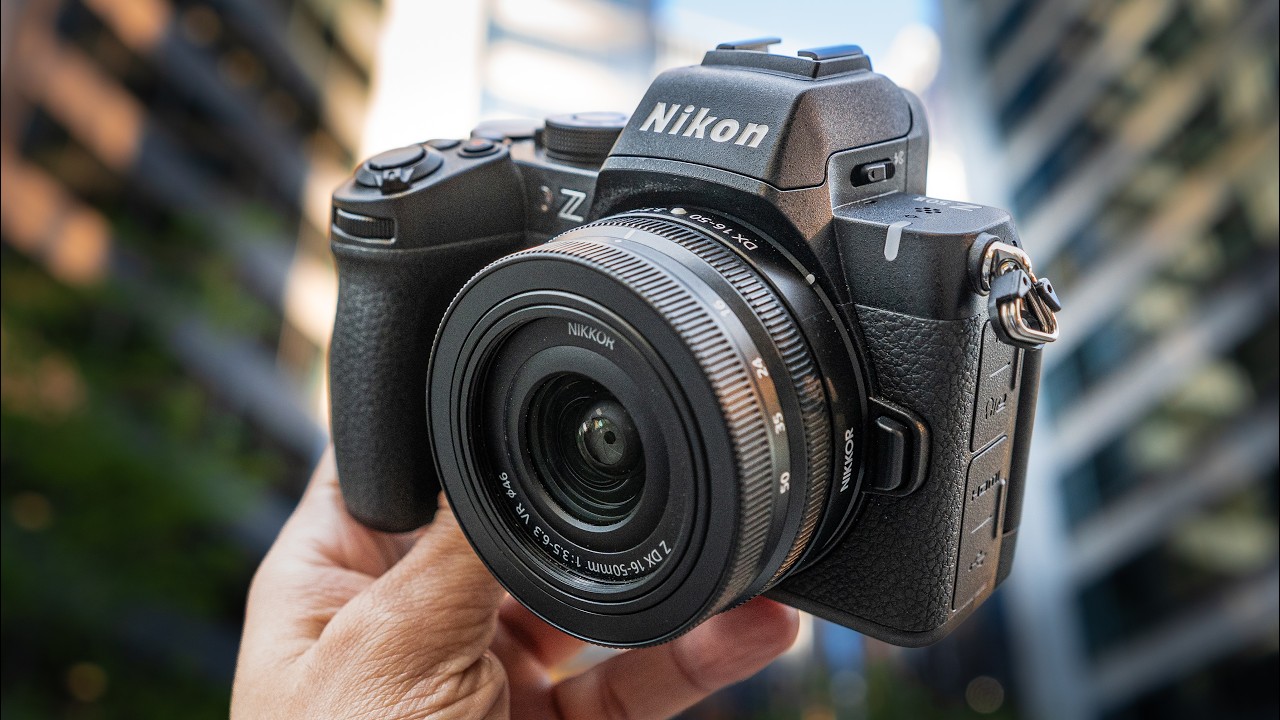
3. Nikon Z30 II - Best for Run-and-Gun Video
The Nikon Z30 was already a hidden gem when it launched, and the second-generation update addresses its most significant weaknesses: battery life has been substantially improved, the rolling shutter in 4K mode is now much better controlled, and Nikon has added a basic but functional log profile that makes colour grading considerably easier in post.
What makes the Z30 II special is how light and unobtrusive it is. At just over 300g body-only, it's genuinely pocketable with a compact prime lens, making it ideal for street photography, documentary work, and any situation where you don't want to draw attention to yourself. The Z-mount has some excellent affordable options, including the legendary Nikon NIKKOR Z 28mm f/2.8 SE, which pairs beautifully with this body.
The absence of an electronic viewfinder remains a sticking point for some users, but for video-first shooters who live on the flip screen, it's rarely a problem in practice.
Verdict: The Z30 II is the best beginner camera for run-and-gun filmmakers and documentary-style shooters who prioritise portability and discretion.
4. Fujifilm X-S20 - Best for Colour Science and Creative Shooting
Fujifilm occupies a completely different space to Sony, Canon, and Nikon in this category. The X-S20 isn't the most technically impressive camera in this lineup - its autofocus, while much improved, still lags slightly behind Sony and Canon in complex tracking scenarios. But if you're drawn to photography as a creative practice, Fujifilm's film simulations and analogue-inspired controls offer something genuinely unique that no spec sheet can fully capture.
The X-S20 shoots beautiful, film-like JPEGs straight out of camera using Fujifilm's renowned film simulations - Provia, Velvia, Classic Chrome, and the newer Reala Ace - meaning you can spend less time in post and more time shooting. For content creators who want their work to have a distinctive, recognisable aesthetic without heavy editing, the X-S20 is compelling in a way that purely technical cameras simply aren't.
It's also worth noting that the X-S20 has a fantastic battery life for its class, and the XF lens ecosystem is mature, diverse, and home to some of the best APS-C lenses ever made.
Verdict: Not for everyone, but for creative souls who want their camera to inspire them, the Fujifilm X-S20 is unlike anything else at this price point.
"The biggest mistake beginners make is buying a camera they've never held. Specs mean nothing if the camera doesn't feel right in your hands, or if the menu system makes your brain melt every time you try to change a setting. Rent first, buy second - always." - Jamie H., filmmaker and LighRent gear owner, Dubai.
Beginner Camera Comparison Table: 2026 Roundup
| Camera | Sensor | Max Video | Autofocus | Best For | Approx. Retail Price |
|---|---|---|---|---|---|
| Sony ZV-E10 II | APS-C 26MP | 4K 60fps | Excellent | Content creators, vloggers | ~AED 3,700 |
| Canon EOS R50 V | APS-C 24.2MP | 4K 30fps (no crop) | Excellent | Hybrid photo/video | ~AED 3,900 |
| Nikon Z30 II | APS-C 20.9MP | 4K 60fps |